Search engines are no longer about matching keywords. They have learnt about intent, context, and connections among topics.
This shift is supported by structured data. It assists search engines in understanding the contents. The schema markup offers such a structure.
It bridges your content and search engine comprehension. In its absence, content may be misunderstood. This is why learning what is schema in seo and the types of Schema in SEO is critical to contemporary SEO.
What is Schema in SEO?
Schema in SEO are structured information that is defined by schema.org. It is typically applied with the help of JSON-LD.
It assists search engines in comprehending entities, their attributes, and relations. A schema contextualizes, unlike simple metadata. Page details are provided in metadata. Microformats are not very structured.
Why is schema markup Important?
Schema enhances comprehending and presenting content. It promotes visibility, aids in contemporary search, and increases competitiveness with regard to listing.
- Improves SERP real estate.
Schema supports such rich results as ratings, frequently asked questions, and carousels. These properties increase your listing area. Increased visibility helps get attention and to perform better in competitive search results.
- Enhances CTR through visual improvements.
Listings are more attractive with such elements as stars, prices, and breadcrumbs. Structured results are more trusted by the users. This enhances clicks and better engagement.
- Enables semantic search
Schema assists search engines in comprehending entities and relationships. It minimizes reliance on keywords. This enhances relevance to the wider and more contextual queries.
- Voice search is supported and AI-driven results.
Voice assistants and AI systems are fed with structured data. It gives definite responses. This enhances the possibilities of featuring in voice and generative search results.
- Minimizes ambiguity in interpreting content.
A schema defines what you have to say. It removes confusion. This will guarantee proper indexation and improved relevancy to the user intent.
Classification of Schema Types (Strategic View)
Schema ought to be deployed in a strategic manner. It should also correspond to user intent, the content format and the kind of SERP feature that you desire to attain.
- Types of Schema in SEO Based on Search Intent
Schema must be in line with user intent. An article or FAQ provides answers to informational schema. Structuring is enhanced with the help of navigational schema, such as Breadcrumb. Such a schema as Product makes transactions. Local schema creates trust and enhances local search.
- Types of Schema in SEO Based on Content Format
Schema will be different in different formats. Articles use BlogPosting. Videos use VideoObject. FAQPage or HowTo is used as interactive content. Schema used on data in the format of a dataset. A similar format will guarantee improved indexing and comprehension.
- Types of Schema in SEO Based on SERP Features Triggered
Schema influences SERP functions. Rating and prices are displayed in rich snippets. Authority is created by knowledge panels. Carousels improve discoverability. Expansions of FAQ enhance visibility. Select a schema according to the appearance of the desired result.
High-Impact Schema Types
Certain types of schemas have more impact. They directly affect the visibility, CTR and authority of search results.
1. Article & BlogPosting Schema
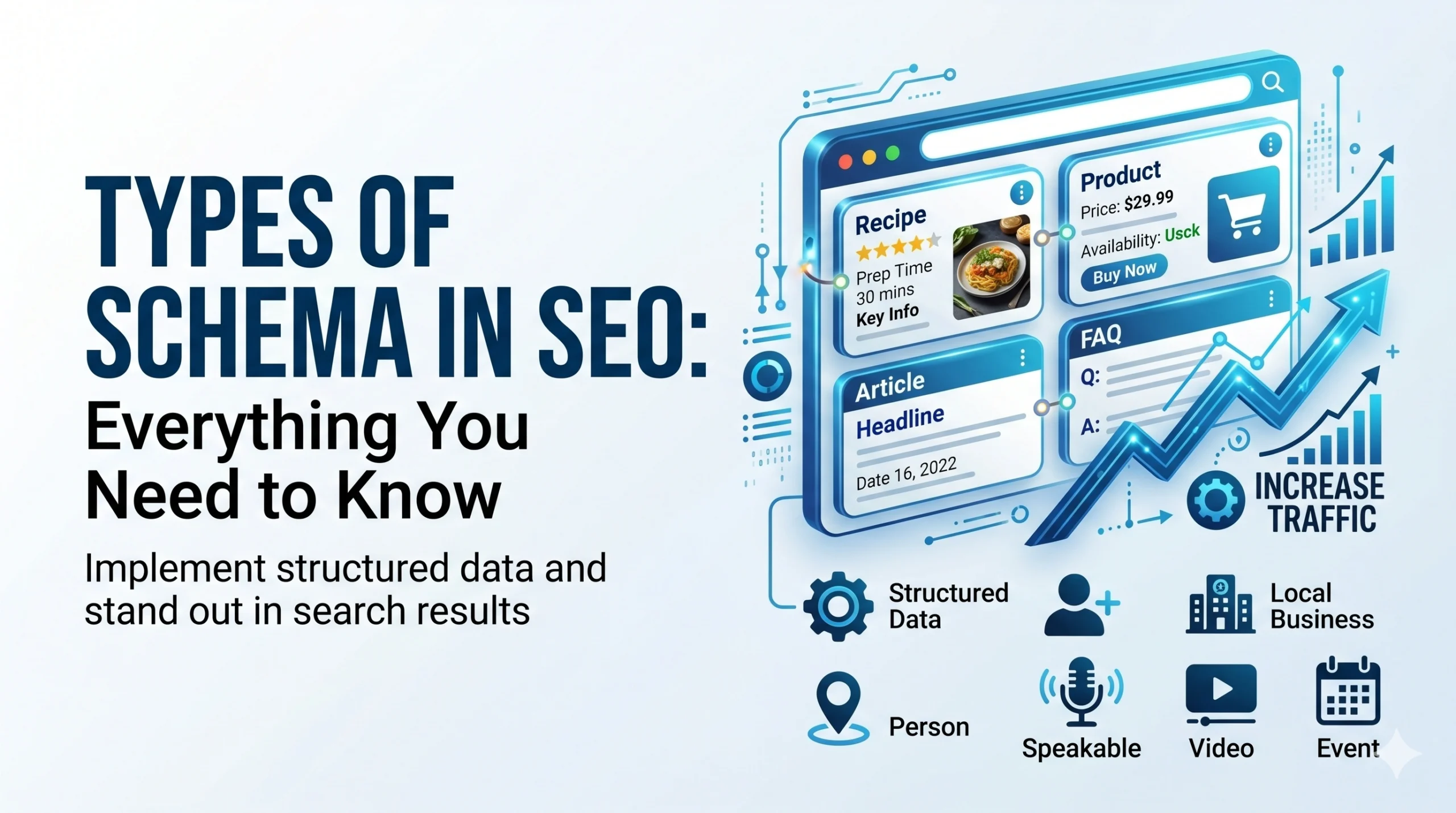
This schema specifies authorship, headline and publish date. It enhances local power. It also favors E-E-A-T as it has the potential of clearly link content to verified authors and sources.
2. Product & Review Schema
Product schema puts an emphasis on price, availability and ratings. Review schema develops trust. Nonetheless, bogus or fraudulent information may prompt fines. The structured data should always be matched to visible content.
3. FAQ Page & HowTo Schema
The schema of FAQ is most applicable to real questions. Overuse reduces effectiveness. HowTo schema is appropriate with step-wise instructions. Correct organization enhances the possibilities of being featured in improved search results.
4. LocalBusiness & Organization Schema
This schema provides uniform NAP information. It is interconnected with Google Business Profile. SameAs links enhance brand loyalty and create brand trust.
5. Breadcrumb Schema
Breadcrumb schema enhances the clarity of navigation. It assists search engines in knowing the hierarchy of the sites. It also promotes SERP presentation and user experience.
6. VideoObject Schema
Video schema facilitates a more powerful indexing of the video material. It helps to highlight important events and enhance video search and Discover functionalities.
Advanced Implementation Strategies
It does not take a basic schema. Advanced strategies are accuracy-oriented, scalable, and search intent-oriented.
- Entity-first SEO: Begin by determining the important entities in your content. Map their relationships. Then apply the schema. This enhances semantic relevance and enables search engines to comprehend more in-depth.
- Combining several schema types: Combine various schema types as necessary. Make sure that they are logically related. Nesting is useful in keeping the relations and preventing the confusion of search engines.
- Topic cluster schema: Implement schema on pillar and support pages. Relate them to common things. This enhances topical control and enhances the general content organization.
- Dealing with large-scale websites: Enterprise websites require a programmatic schema. Apply templates and the validation process. Regularly monitor performance to make it accurate and effective.
Conclusion
Schema has now become the mainstay of present-day SEO. It enhances the way of understanding and presenting your content by search engines.
In its absence, there is a loss of visibility opportunities. When one takes the right approach, the results are greatly enhanced.
At Ramyatech, we work on systematized, purposeful applications. Our professionals chart out types of Schema in SEO, choose the appropriate schema, and make sure that it is executed properly.
We do not simply mark up. We create a system that endorses development. Types of Schema require a strategic and expert-based approach in order to maximize their benefits in terms of SEO.
FAQs
Q1. Does schema markup have a direct positive/negative impact on rankings?
Ans 1. No. It enhances visibility and CTR which have indirect effect to SEO performance.
Q2. Is it possible to have several types of schema on a page?
Ans 2. Yes, but they need to be organized correctly and be logically interrelated.
Q3. How can I test my schema?
Ans 3. Testing performance and monitoring should be done with the help of Google Search Console and structured data testing tools.