

Your website does not display to search engines as it does to your users. They use systematic cues to learn and find pages.
This is where sitemaps come into play. The Difference Between Html and XML sitemaps is vital when you want to have a higher level of crawling, indexing and user navigation.
Both types are explained in this guide. It also demonstrates the time to employ each of them as a strategic measure.
What is a Sitemap?
A sitemap is a well-organized directory of the URLs in your site. It assists the search engines and users in searching through your content.
Consider it as a roadmap. It indicates to search engines the location of pages. It also displays the connection between pages.
The two main audiences are:
- Search engines: would require structured data.
- Users: should have convenient navigation.
Crawl efficiency is also facilitated by sitemaps. This is significant when the websites are large or complicated. Sitemaps can be even more useful if your internal linking is lacking.
Why Sitemap is Important in SEO?
In order to have a clear explanation as to why sitemap is important, you must consider the manner in which search engines work.
They are crawlers that use bots to navigate the web. A sitemap will give optimization on how that budget is utilized.Search engines are given an ordered route as opposed to accidentally stumbling upon pages.
This is how it will affect the practical aspect of SEO:
- It makes sure that no vital pages are overlooked, particularly weakly linked pages.
- It accelerates the indexing of new content or new content that has been updated.
- It offers structural clarity, which aids in more enhanced ranking signals.
- It lessens reliance on backlinks to be found.
This is where the use of XML and HTML sitemap begins to vary. One is in favor of technical discovery. The other enhances usability and interlinking.
Understanding XML Sitemap
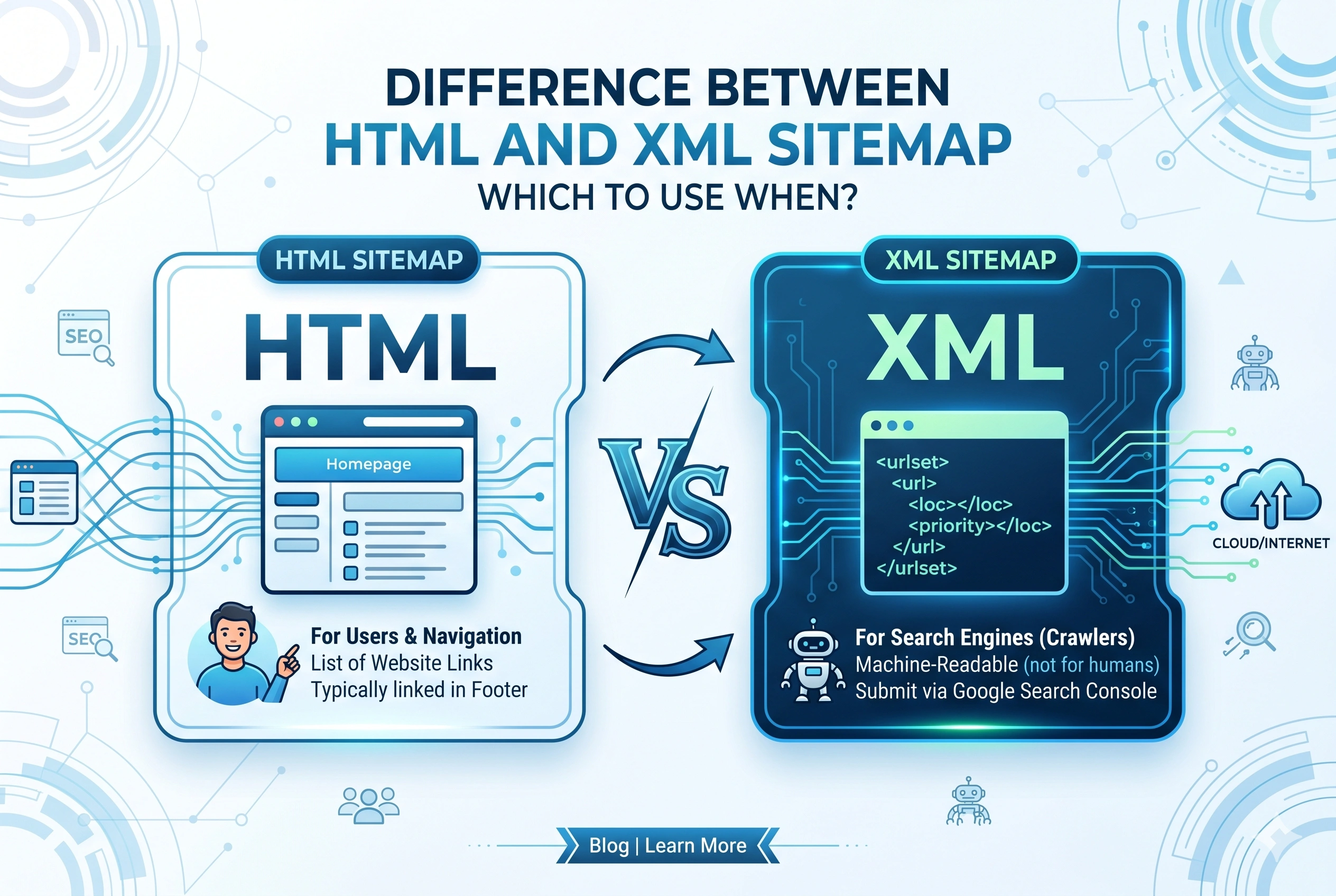
XML sitemap is a file that can be read by machines. It is search engine friendly. It contains such important details as:
- URL location
- Last modified date
- Frequency of change (no longer important today)
- Priority (a hint, not a rule)
You tend to file it via Google Search Console. This makes it accessible to the search engines.
Important insight: An XML sitemap would not assure indexing. It merely gives a good clue. There is still the quality and relevance that are considered by search engines.
XML sitemaps can be divided into segments in large websites. You can have individual files of blogs, products and categories. This enhances management and crawling.
Practically, both XML and html sitemap can be used in various levels of SEO. XML handles discovery. HTML supports structure.
Understanding HTML Sitemap
A sitemap is an HTML page that is visible on your site. It can be accessed by the users. It enumerates significant pages in a tabulated manner.
This improves navigation. It is also useful in assisting the user to locate material quickly. As far as SEO is concerned, it does even more than that:
- Allocates inner link equity.
- Reduces crawl depth
- Strengthens site architecture
An effectively created HTML sitemap adheres to hierarchy. It classifies pages in terms of categories and subcategories.
This comes in handy particularly where:
- Big blogs containing hundreds of posts.
- In-depth ecommerce websites.
- Poor menu of websites.
HTML sitemaps are both UX and SEO resources.
Difference Between HTML and XML Sitemap
| Factor | XML Sitemap | HTML Sitemap |
| Primary Audience | Search Engines | Users |
| Format | XML (machine-readable) | HTML (user-friendly page) |
| Visibility | Not visible to users | Publicly accessible |
| SEO Role | Helps indexing & crawling | Improves UX & internal linking |
| Crawl Priority | Direct hint to bots | Indirect via links |
| Use Case | Large, dynamic, poorly linked sites | Navigation-heavy, content-rich sites |
| Submission | Via Search Console | No submission needed |
| Impact | Indexation efficiency | Link equity distribution |
XML vs HTML Sitemap: Strategic Use Cases
XML and HTML sitemap do not have to be chosen. It involves getting to know what you want with your site.
In case there is no authority or your site is new, then the search engines might not find your pages. An XML sitemap is then essential in that instance. It is a direct indicator to the search engines.
Conversely, when your website contains hundreds of pages and is deeply structured, users might not be able to navigate. It is there that the HTML sitemap comes in handy.
The model is a simplified view of the decision:
XML sitemap should be used when:
- Your site is big or dynamically created.
- There is poor interlinking of pages.
- You desire quicker indexing.
HTML sitemap should be used when:
- Your Web architecture is complicated.
- Navigation needs improvement
- You would like to have improved internal link distribution.
Implementation Best Practices
A sitemap can only be effective when done right. Inadequate implementation decreases its value.
XML Sitemap
Be clear and to the point. Only include important pages. Avoid unnecessary URLs. Make sure that it updates automatically when the content is changed.
In addition, it should always be submitted using Google Search Console. This makes sure search engines are aware of it.
HTML Sitemap
Structure matters here. Dumping of links is not just dumping. Organize them logically. Make it scannable and readable.
Position it in a convenient place for the users. It is incorporated in most websites in a footer.
Combined Strategy
Your sitemap must be representative of your real site structure. Not aligning your internal linking and sitemap sends mixed signals to search engines. Consistency is key.
Conclusion
Understanding the Difference Between Html and XML Sitemap allows you to move beyond basic SEO and build a structured website.
XML sitemaps make sure that your content is found effectively by search engines. HTML sitemaps enhance navigation and internal links.
We do not use sitemaps as checklists at Ramya Technosoft. Our specialists create them according to your site structure, flow of content and indexing requirements.
This leads to improved crawl performance, improved visibility and sustainable SEO development.
FAQs
Q1. Do XML sitemaps directly improve rankings?
Ans 1. No. They enhance crawling and indexing performance, which indirectly facilitates the enhanced ranking performance in the long run.
Q2. Will HTML sitemap be sufficient?
Ans 2. No. HTML assists users and intra-linking, whereas XML needs to be discovered by the search engines.
Q3. What is the number of URLs per XML sitemap?
Ans 3. Preferably less than 50,000 URLs per file. The bigger ones ought to be divided into several sitemappings.