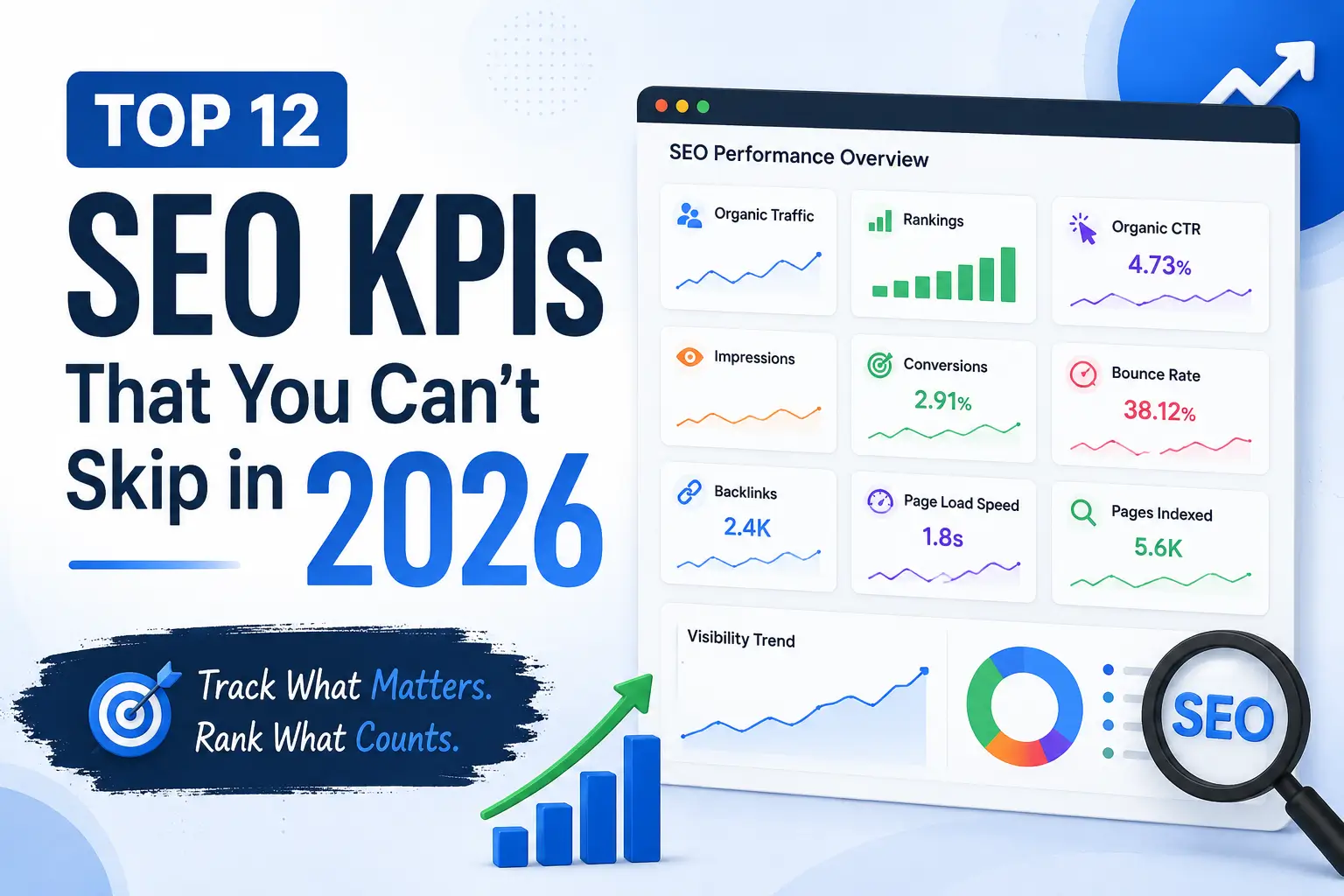
Search Engine Optimization (SEO) refers to the practices used to rank a page in search engine results to increase its visibility and visitor traffic from search. But it is not a simple job to implement SEO strategies; you must also find a way to measure their results. That is where SEO KPIs will come in handy.
They help companies understand what works, where to improve, and make evidence-based decisions to increase visibility, traffic, and conversions.
Regardless of whether you are a business owner, marketer, or SEO professional, the key to long-term SEO success is the ability to track the right metrics.
What are SEO KPIs?
SEO KPIs ( Key Performance Indicators ) are the quantifiable indicators that gauge the success of your SEO strategy. They indicate whether your site is making progress in search rating, getting the right people, or providing the business with quality results.
Top 12 SEO KPIs You Should Track in 2026
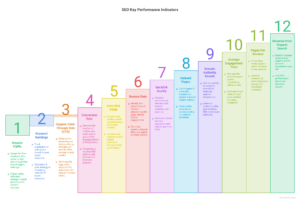
All businesses have different purposes for SEO, but some metrics are important because they help gauge long-term performance. The KPIs presented below provide an in-depth perspective on your site’s visibility, user interaction, and overall SEO performance.
1. Organic Traffic
Organic traffic is used to gauge the flow of people who come to your site through free search engine rankings. It is among the most basic SEO indicators: the higher the organic traffic, the stronger the search presence and content success.
2. Keyword Rankings
Rankings are placed on keywords that your web pages are ranked on, based on your target keywords. Tracking keyword placement will help you determine whether your search engine optimization strategy is increasing the visibility of your target keywords.
3. Organic Click-Through Rate (CTR)
Organic CTR is measured as the percentage of visitors who go through your Web site upon visiting it after viewing it in search results. Having a high ranking does not always guarantee traffic because unless users are interested in your listing it will not be appealing.
Clicks and qualified organic traffic can be greatly increased by optimizing the title tags, meta descriptions, and structured data.
4. Conversion Rate
Business is not created with traffic. Transformation rate is a measurement of the number of visitors who make useful actions such as buying a product, filling in a form of contact, reserving a consultation or newsletter subscription. Monitoring conversions will aid corporations to comprehend whether SEO will be adding to the real revenue and business purpose other than boosting a higher amount of visitors to the website.
5. Core Web Vitals
Page experience is a key ranking factor at Google. Core Web Vitals assess the page loading speed, responsiveness and visual stability during the loading of the page. Optimization of these metrics increases user experience, decreases abandonment and helps with improved search placement in the long term.
6. Bounce Rate
The bounce rate is the percentage of visitors abandoning the page by not engaging further. With a high bounce rate, it is not necessarily a bad thing, but a persistent high bounce rate can be a sign of poor relevance of the content, slow loading or poor user experience. The quality of content, internal links, page speed, and user engagement can be optimized to create an opportunity to retain visitors and encourage them to visit more pages.
7. Backlink Quality
The backlinks continue to be among the strongest ranking factors of Google, but quality is much more valuable than quantity. The authoritative, relevant, and trusted websites have links with a lot more SEO value than multiple links with low quality. Keeping track of the quality of backlinks assists companies in achieving a more robust domain reputation and reduces the chances of spammy or unhealthy backlinks undermining search results.
8. Indexed Pages
Indexed pages are defined as the number of pages of a web site that have been located and placed in index by search engines. Without indexing, it is not possible to show important pages in search results, no matter their optimization of the page. Periodically revising index coverage can assist in noticing crawling or technical SEO problems before they affect visibility.
9. Domain Authority Growth
Domain Authority (DA) is not a Google ranking factor, but is a useful metric that allows you to have a comparison of overall authority of your site versus competitors. The enhancement of the quality of the content, gaining authoritative backlinks, and good technical search engine optimization can lead to a slow increase in the domain authority.
10. Average Engagement Time
Average engagement time is the time that users spend interactively with your site. Increased time is typically an indication that visitors consider your content worthwhile and useful. Good content, easy navigation, and great graphics, as well as clarity in internal links, motivate to spend more time on your site.
11. Pages Per Session
This Key Performance Indicator is used to gauge how many pages a visitor browses in one session. The larger one is usually indicative of good internal connecting, useful content and a good user experience. Companies can increase this measure by developing topic groups and referring the readers to correlated resources.
12. Revenue from Organic Search
Finally, SEO must help to grow the business. By monitoring your revenue that comes in by organic search you can tell whether your investment in SEO is paying off. Monitoring this KPI allows linking SEO performance to business results, not to the site’s rankings or traffic.
Conclusion
The right SEO KPIs can help companies determine whether the optimization process is yielding significant results. Organizations should not just concentrate on rankings but also evaluate the quality of traffic, user engagement, conversions, technical performance, and revenue to establish a long-term SEO program.
Ramya Technosoft, an organic seo company can assist when you need an organic search agency that takes care of technical expertise, data-driven approaches, and performance measurement.
We specialize in enhancing search visibility, optimizing performance, and tracking the most important KPIs so that businesses can grow organically in the long term and achieve greater online success.
FAQs
Q1. What are SEO KPIs?
A. SEO KPIs are quantifiable measures that can be used to determine the performance of your SEO strategy. They assist companies in monitoring rankings, organic traffic, conversion, user engagement, and the general search visibility.
Q2. Which are the best SEO KPIs to track?
A. Organic traffic, keyword rankings, conversion rate, Core Web Vitals, quality of backlinks, organic CTR, engagement time, and revenue based on organic search are some of the best SEO KPIs.
Q3. How often should SEO KPIs be monitored?
A. SEO KPIs should be reviewed monthly by most businesses, but weekly could be beneficial for high-traffic websites and competitive industries to identify trends and optimize performance in the shortest possible time.