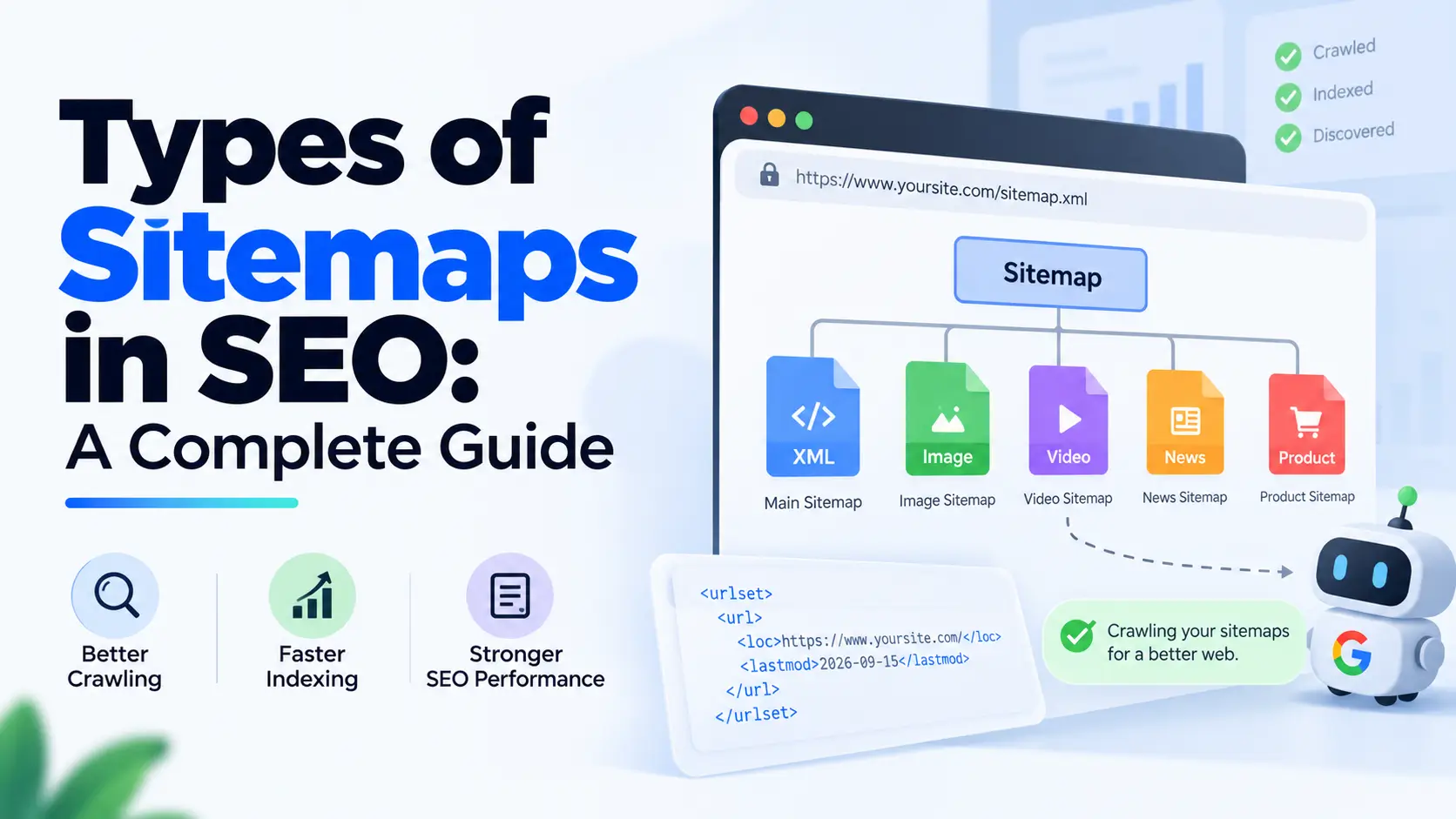
To help search engines discover important pages efficiently, understanding the Types of Sitemaps in SEO is essential. A sitemap tells search engines which URLs you want them to discover and is especially useful for large, new, or complex websites.
Key Takeaways
- XML sitemaps help search engines discover URLs.
- HTML sitemaps can support navigation.
- Image, video, and news sitemaps serve specialised content.
- Sitemap indexes organise multiple sitemap files.
- A sitemap supports discovery but does not guarantee indexing.
What Is a Sitemap in SEO?
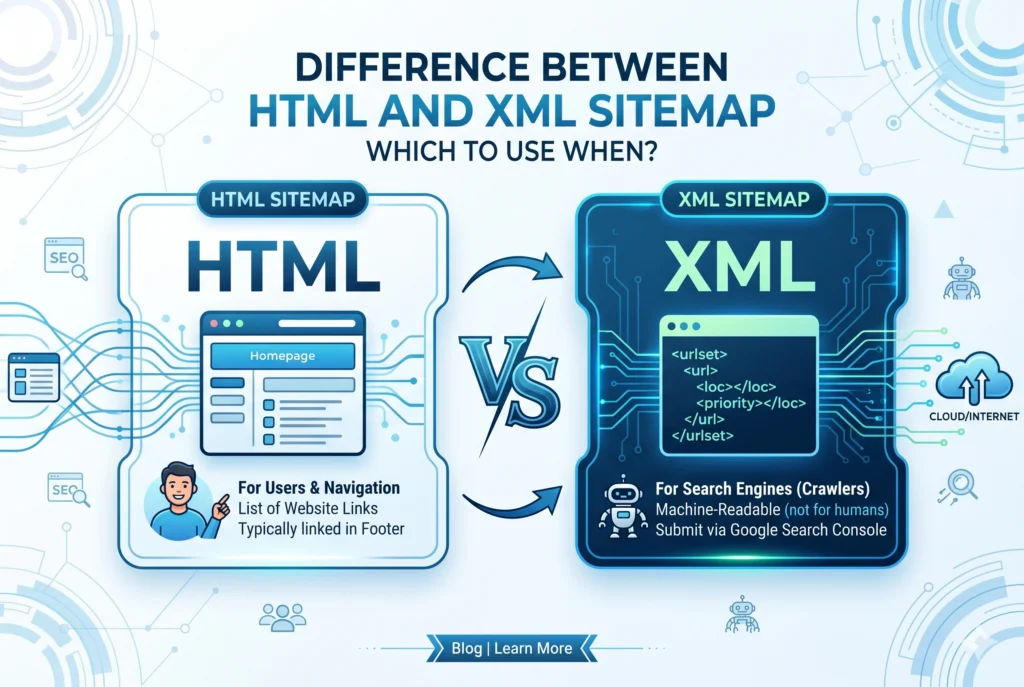
A sitemap gives information on significant URLs of a web site especially where crucial pages cannot be easily located. XML sitemaps are primarily used with search engines, whereas HTML sitemaps can be read by humans and they can facilitate navigation.
What Are the Main Types of Sitemaps in SEO?
Below we have covered 6 crucial types of Sitemaps in SEO:
1. XML Sitemap
XML sitemap is the most significant type of sitemaps to most websites. It contains URLs that you would like search engines to know about and could contain data like time of last modification which aids search engines in knowing when the content was last modified.
It can be used in an ecommerce site to aid the search engine to find valuable product, categories, and other pages.
2. HTML Sitemap
The HTML sitemap is a webpage that has links to significant pages. It primarily targets users, although it can also offer crawlers an additional avenue through which they could find something.
3. Image Sitemap
An image sitemap gives search engines details on the images related to content on the site. It may be handy in ecommerce shops, portfolios and image-intensive websites where visual search index is important.
4. Video Sitemap
A video sitemap tells information through video content and it aids in enabling search engines in finding video content as well as an insight of the pages associated with it.
5. News Sitemap
A news sitemap is targeted towards those websites that publish news regularly. It may assist search engines to find latest published news effectively.
6. Sitemap Index
A sitemap index directs the search engines to several sitemap files. It comes in handy in cases where a website requires breaking of URLs into multiple files depending on the size, the type of content or architecture.
Which Sitemap Should Your Website Use?
The sitemap you should have will depend on your purpose, the size of your website and the content of the site.
An XML sitemap is valuable to virtually any site, however, specialised sitemaps are important when there is a particular form of content on your site.
- Business & Service Websites: Use an XML sitemap to assist the search engines in finding valuable service and location, about and contact pages. Navigation on more business-size websites can also be facilitated by an HTML sitemap.
- Ecommerce Websites: Create a XMLsitemap on significant product, category, and collection pages. When product images make a significant contribution to your search presence, an image sitemap may be of benefit as well.
- News & Publishing Websites: Provide an XML sitemap and news sitemap to ensure that search engines can easily find out the articles and other crucial editorial information published recently.
- Video Websites: The sitemaps that need to be used include XML sitemap and video sitemap whenever video content comprises a significant portion of the site. Sitemap video can give more details on the videos published.
- Image-Heavy Websites: An image sitemap can be added to the existing XML sitemap on photography websites, portfolios, and other visual platforms.
- Large Enterprise Websites: A sitemap index can be used to structure multiple XML sitemaps between sections, categories, products, services, or other logical groupings in large sites with thousands of URLs.
- Blogs & Content Websites: A typical XML sitemap will suffice for blogs. It must feature significant published posts and relevant pages and none of the non-indexable URLs, duplicate, or irrelevant pages.
- Local Business Websites: Key service, location and business pages should be addressed in an XML sitemap. With a large number of location pages on websites, the organization and update of URLs becomes of special importance.
What Should You Avoid Adding to a Sitemap?
Your sitemap should contain only important, indexable URLs. Adding unnecessary or problematic pages can make your sitemap less useful for search engines.
- Avoid Redirected URLs: Do not include URLs that redirect to another page. Add the final destination URL instead.
- Exclude Duplicate URLs: Keep duplicate or near-duplicate versions out of your sitemap and include the preferred canonical URL.
- Remove Noindex Pages: Pages with a noindex directive generally should not be included because you are telling search engines not to index them.
- Skip Error Pages: Never add URLs returning 404, 410, or server errors. These pages provide no useful destination for search engines.
- Avoid Blocked URLs: Do not include pages that are intentionally blocked from crawling when you want the sitemap to represent your accessible, indexable content.
How Do Sitemaps Support SEO?
Sitemaps are not, in themselves, the key to better rankings. Their primary aim is to help search engines find relevant URLs. But a sitemap will not be a strong tool to balance substandard technical SEO. There are still pages that have to be involved, useful, and well linked and can be indexed.
How Should You Maintain Your Sitemap?
A well-maintained sitemap helps search engines discover important pages efficiently while preventing outdated or incorrect URLs from wasting crawl resources.
- Remove Outdated URLs: Remove deleted, redirected, duplicate, and non-canonical URLs regularly to ensure your sitemap contains only relevant pages you want search engines to discover.
- Add New Pages: Whenever you publish valuable new pages, add them to the appropriate sitemap so search engines can discover your latest content efficiently.
- Check URL Status: Ensure every sitemap URL is accessible and returns a 200 OK response. Remove URLs that produce errors, redirects, or indexing restrictions.
- Review After Major Changes: After migrations, redesigns, or URL restructuring, review your sitemap carefully to ensure every listed URL matches your website’s updated structure and hierarchy.
Conclusion
Learning the types of sitemaps assist you in determining the format that suit your web page. Most companies have XML sitemap as the core with the image, video, news, HTML, and sitemap index formats as additional types that are applied based on the content, scale and structure rather than applying all sitemaps types unnecessarily.
When your site has been crawled, indexed, content discovered, or has other technical SEO needs, consider a more comprehensive approach to it, which Ramya Technosoft can assist with.
The company offers technology and digital services, such as SEO services, to assist businesses to enhance their online presence.
To hire a skilled and customized Organic SEO Services and technical knowledge regarding your site, contact Ramya Technosoft and establish a better search base.
FAQs
Q1. What is the most important sitemap for SEO?
For most websites, the XML sitemap is the primary sitemap because it helps search engines discover important URLs and focus your crawling signals on the pages that matter most.
Q2. Does a sitemap guarantee indexing?
No. Submitting a sitemap helps search engines discover URLs but does not guarantee crawling or indexing.
Q3. Do small websites need a sitemap?
A small website can still benefit from an XML sitemap, especially when it has new pages, limited internal links, or content that is difficult to discover.
Q4. How often should a sitemap be updated?
Update it whenever important URLs are added, removed, or significantly changed. Automated generation is preferable for frequently changing websites.