Search is no longer influenced by individual keywords. Google has now started assessing knowledge in whole topics. That change renders What is Topical Authority in SEO an essential notion to contemporary rankings.
It determines the level and the degree to which a topic is covered by a site. Google does not rank individual pages but evaluates mastery of an individual subject. Websites that exhibit organized information gain greater visibility.
Working with an organic SEO company can also help businesses build a strong content strategy focused on topical relevance and long-term search visibility.
In this blog, you will find out how the topical authority functions, what Google considers in relation to the topical authority, and how you can strategically build the topical authority with the help of Google.
What is Topical Authority in SEO?
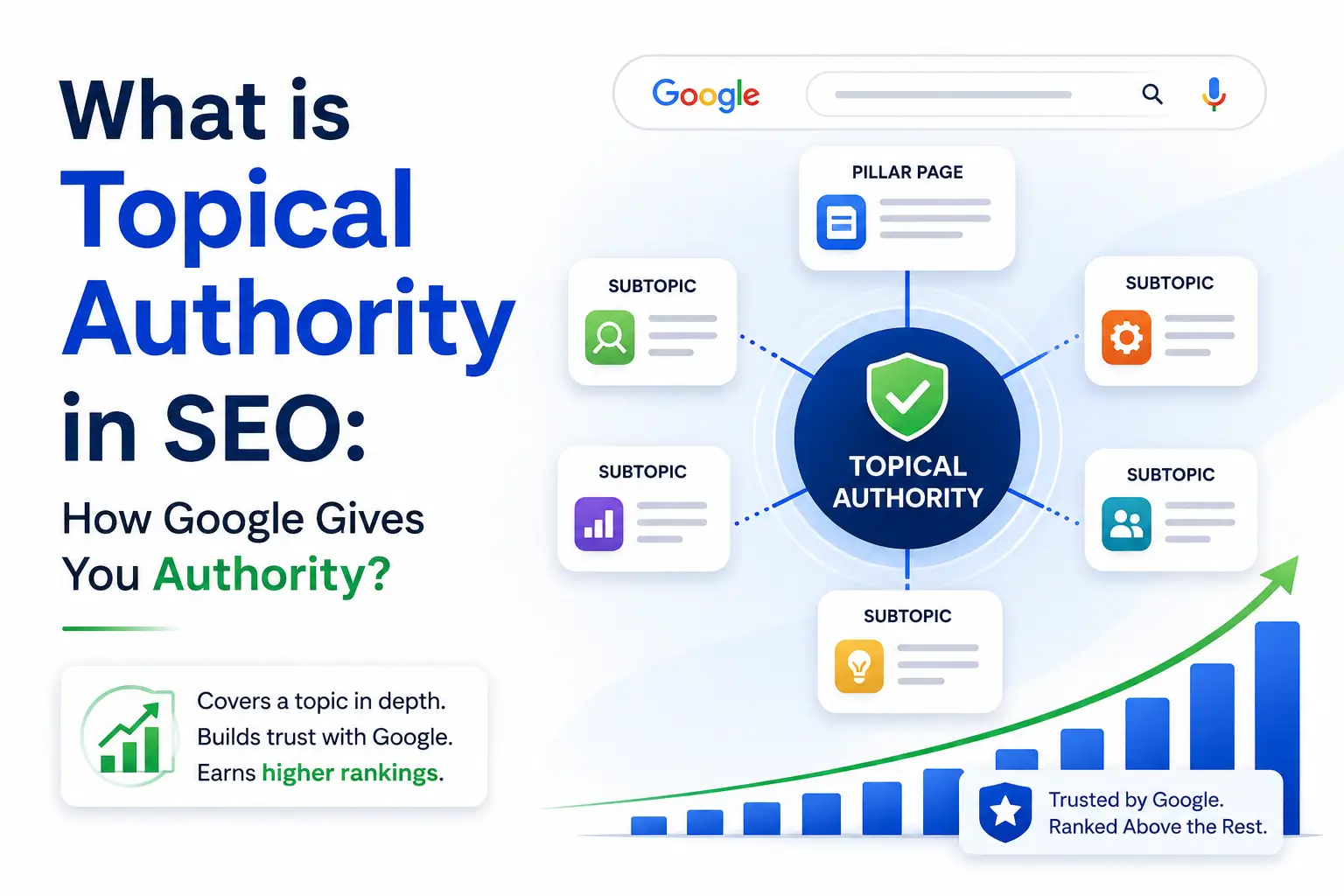
Topical authority is the capacity of a website to demonstrate profound knowledge on a topic by having well-structured and connected content. It is more concerned with addressing a whole subject matter, rather than ranking individual pages.
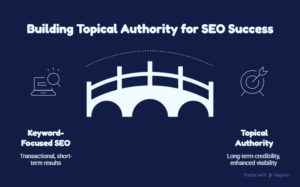
SEO based on keywords focuses on certain words. It is transactional and short-term. Topic-based search engine optimization is based on a comprehensive coverage of the topic. It establishes long-term credibility and enhances visibility in general.
Key concepts:
Semantic search: Google is not merely a search engine; it is also a search engine that understands intent and context, rather than just keywords. It ranks materials that answer a subject matter completely.
Entity-based indexing: Google links people, brands, and concepts to assess expertise, not based on keywords.
Google has a depth, breadth and trust measurement of authority. Frequency guarantees the contents in detail. Breadth is a complete coverage of topics. Consistency and user interaction bring about trust.
How Google Actually Measures Topical Authority?
The metrics of authority, as seen by Google, use structured signals based on content, links and entities, as well as the real patterns of user behaviors.
Entity Recognition & Knowledge Graph Signals
Google recognizes such entities as brands, topics and authors. It visualizes relationships with its Knowledge Graph. When your content is always linked to the same entities, this is an indication of expertise. There is a good entity association that enhances topical relevance. Mentions, structured information and contextual consistency assist Google in knowing exactly what your site is all about.
Content Depth vs Content Coverage
The content that is long in itself does not create authority. Depth involves elaborating a subject clearly with levels of information. Coverage refers to the coverage of all the related subtopics. One long article is not going to have a structured content ecosystem that is structured. The ten shallow blogs fail to connect, complete, and have strategic intent.
Internal Linking & Topic Clustering Signals
Internal links direct Google to the structure of your content. They demonstrate the relationships between the topics. A pillar page would be a central node. Articles that are in support broaden subtopics. This cluster model enhances the crawl effectiveness. It further strengthens the subject knowledge by establishing logical connections and the use of contextual anchors.
User Interaction Signals (Behavioral SEO)
Google follows the interaction of the users with the content. Dwell time demonstrates the level of engagement. Pogosticking indicates dissatisfaction. Repeat customers are an indicator of trust. Great interaction implies the quality of content. Google perceives it as the reinforcement of authority over that subject when users spend longer on the search engine and visit it frequently.
Why Topical Authority is the New Ranking Currency?
Google prioritizes expertise-driven content. Authority now determines visibility more than isolated keyword optimization strategies.
Google updates shifting toward expertise – Recent changes reward useful, people-first content. The key pages become fanciful. Regular, quality content creates ranking permanence in the long-term.
Why niche sites outperform general blogs – Focused sites are in-depth and cover one topic. This strengthens relevance. Large websites water down power by discussing irrelevant issues.
Impact on rankings, trust, and conversions – Authority is positively affecting rankings in various keywords. It develops trust with the users. More trust creates better engagement and conversion.
How to Build Topical Authority?
Start with a clear niche. Focus on one subject instead of covering everything. Build connected content around that topic. Use internal linking to structure pages. Cover subtopics in depth. Maintain consistency. Over time, this signals expertise to Google and strengthens rankings.
Topical Authority vs Domain Authority vs Page Authority
Topical authority is used to measure the depth of a web site which deals with a particular topic. It concentrates on well-organized, interrelated information within a subject.
Domain authority is a measure of the general strength of a site. It relies on backlinks, age and trust. Page authority is a concept that is applicable to single pages and their ranking capability.
The site might possess high domain authority and low topical relevance if the content is not focused. Equally, a single page can be ranked without the need to establish a long-term authority. Topical authority gives a compounding effect. It enhances the internal connectivity of several pages.
Key differences:
Expert power of topicality → Knowledge of the subject.
Domain authority -Total strength of the whole site.
Page authority – Individual page performance.
Topical authority is more viable. It establishes the rankings and stability on a long-term basis.
Conclusion
SEO success now depends on expertise, not just optimization. Understanding What is Topical Authority in SEO helps shift your strategy toward long-term growth.
It needs to be organized, regularly published, and have a clear focus on the subject matter. This is where RamayaTech and our specialists can come to the rescue.
Our construction of authority-based SEO platforms and not haphazard content. Starting with clustering of topics to internal architecture, each of the stages is strategic. The goal is simple. Develop trust, better rankings, and develop sustainable search visibility.
FAQs
Q1. What is topical authority in simple terms?
It involves going into details of a topic with related content and, as a result, Google perceives your site as an expert source of information.
Q2. How many articles are needed to build topical authority?
No definite number. Avoid producing more articles; concentrate on quality and complete coverage of the topic.
Q3. Does topical authority help new websites rank faster?
Yes, provided that the content is well organized. It establishes trust in a short time and enhances visibility in various related keywords.
Q4. Do topical authority and backlinks have the same level of importance?
Both matter. But topical authority ensures long-term stability, while backlinks mainly boost initial ranking strength.