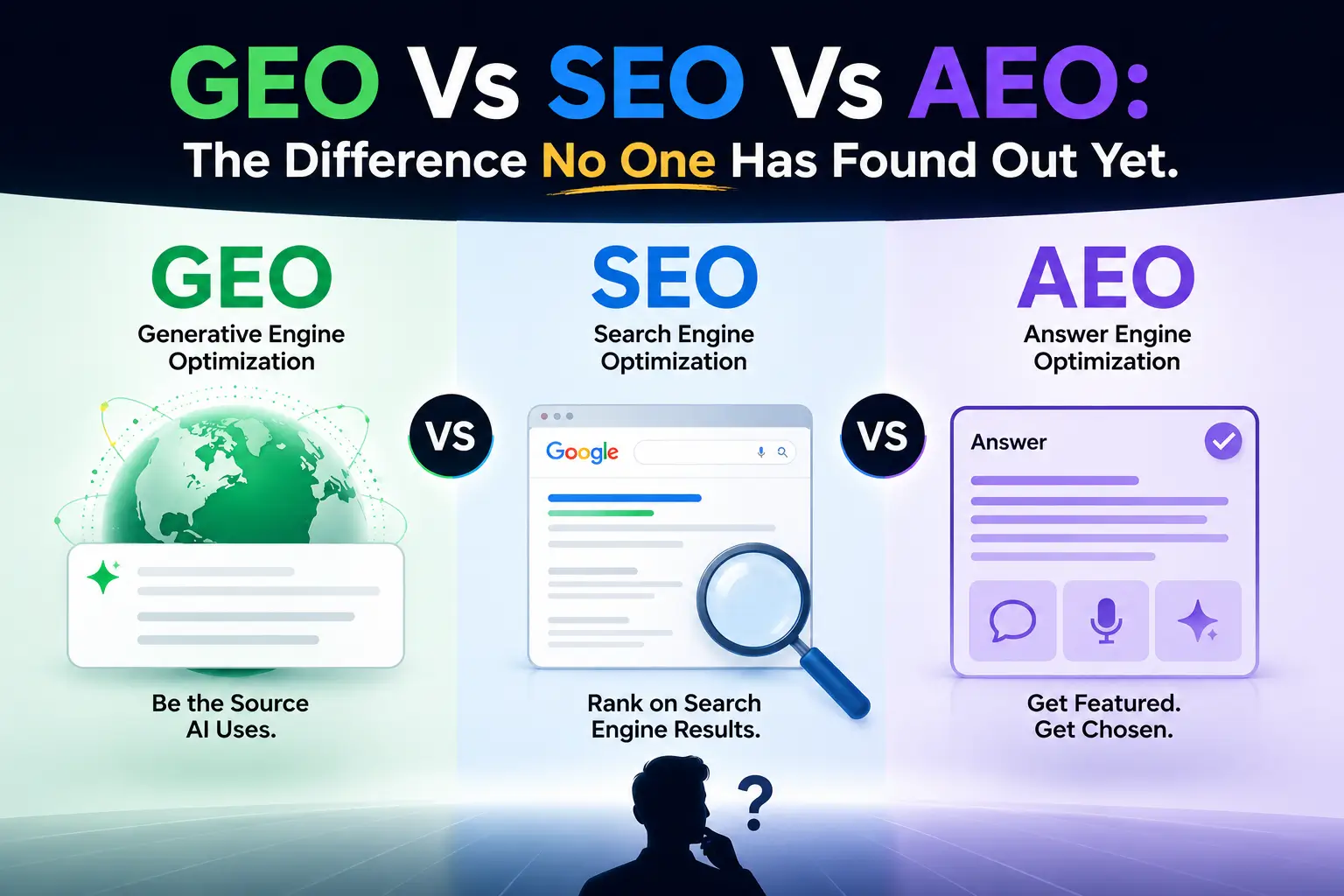
Have you then been getting confused with terms such as GEO Vs SEO Vs AEO, wondering whether the same terminologies are the same thing? You are not alone. With search still evolving beyond traditional platforms into so-called AI-driven platforms, businesses must understand how each strategy functions and where it fits.
SEO can be used to optimize websites to rank on Google, whereas AEO focuses on being the second answer in user searches, and GEO makes your content findable by generative AI programs such as ChatGPT, Gemini, Claude, and Perplexity. These three approaches are vital in developing a digital marketing strategy that is future-ready.
Over the past few years, search behavior has been transformed. Users perform fewer searches using brief keywords on Google, instead posing full sentences to AI assistants and expecting immediate, conversational responses.
This change implies that companies will be forced to fine-tune their content to expand it to search engines and answer engines, and AI-enhanced search experiences.
What is GEO?
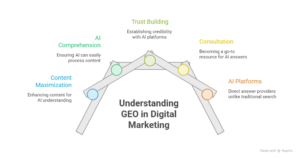
The question still remains with many businesses: what is GEO, and why is it now such a significant component of digital marketing?
GEO is the abbreviation for Generative Engine Optimization. It is a method that allows you to maximize content to ensure that generative AI sites comprehend, trust, and consult your site when providing answers to users.
In contrast to traditional search engines, which present lists of links, AI platforms provide direct answers by examining various reliable sources.
What is SEO?
SEO, abbreviated as “Search Engine Optimization,” is the art of making a website more search engine friendly like Google and Bing. The overall goal of SEO is to increase organic traffic and attract the right visitors by aligning search intent with high-quality content.
SEO has a number of significant elements:
- Keyword research
- On-page optimization
- Technical SEO
- Content creation
- Internal linking
- Link building
- User experience improvements
To give an example, when an individual uses the search query best CRM software Google evaluates hundreds of ranking criteria to decide which web pages have the right to feature at the top.
Though AI search is fast expanding, SEO will continue to be the basis of online presence since search engines continue to generate billions of searches per day.
What is AEO?
AEO is the abbreviation of Answer Engine Optimization. Rather than relying solely on rankings, AEO assists in making your content the first response that users would find in the search results or voice assistants.
Answer engines are more concerned about content that gives precise, concise and reliable answers to particular questions. This encompasses Google Featured Snippets, Google AI Overviews, voice search devices and other answer based search experiences.
AEO generally concentrates on:
- Question-based content
- FAQ sections
- Schema markup
- Structured headings
- Short answer paragraphs
- Clear definitions
As an illustration, when a person queries, What is cloud computing? Instead of a list of websites, Google can include a featured snippet. AEO will give you a better opportunity to get these high-profile answer positions.
GEO Vs SEO Vs AEO: Quick Comparison
| Feature | SEO | AEO | GEO |
| Goal | Improve search rankings | Become the direct answer | Become an AI-recommended source |
| Platforms | Google, Bing | Google AI Overviews, Voice Search | ChatGPT, Gemini, Claude, Perplexity |
| Primary Focus | Keywords & rankings | Questions & answers | AI citations & topical authority |
| Success Metric | Organic traffic | Featured snippets | AI mentions & references |
Understanding the Difference Between GEO, SEO, and AEO
Whereas SEO, AEO and GEO strive to enhance online visibility, they all have different purposes. To gain insight into their differences enables businesses to construct a digital approach that is successful in search engines, answer engines, and AI-driven solutions.
- Search Intent
SEO aims at users who search using keywords in order to obtain appropriate web pages. AEO aims at users who tend to ask direct questions and demand immediate replies, whereas GEO is more focused on conversational AI, where users seek elaborated and context-sensitive answers provided by the platforms such as ChatGPT and Gemini.
- Content Optimization
SEO focuses on the positioning of keywords, technical optimization, backlinks and holistic content. AEO focuses on brief responses, frequently asked questions, well-organized headings and schema markup. GEO also takes it a step further by prioritizing entity optimization, topical authority, semantic relevance, and content that can be easily understood and consulted by AI models.
- Ranking Approach
Conventional SEO will enhance positions in search engine results pages. AEO is aimed to appear in Featured Snippets, AI Overviews, and voice search results. GEO is not about rankings–it wants your content to become a reliable source that generative AI systems use to come up with answers.
- Performance Measurement
SEO success is evaluated based on keyword rankings, organic traffic, inbounding links and conversion. The AEO performance is determined by Featured Snippet visibility, voice search appearances, and the appearance of answer boxes. GEO quantifies success in terms of AI mentions, brand mentions in generative search, topical authority and presence across AI-powered applications.
- Long-Term Business Value
SEO has been a steady source of organic traffic and lead generation. AEO enhances presence through establishing brands as a source of authority to the questions posed by users. GEO makes businesses future-proofed by making businesses more discoverable in all AI assistants as users move away from traditional search engines towards conversational AI.
Conclusion
Realization of GEO Vs SEO Vs AEO is no longer a choice to businesses seeking to remain competitive in the current fast changing search environment.
Whereas SEO will get your site ranked on the search engines, AEO will place your content as the most suitable solution to the users, and GEO will make your brand familiar with AI-based engines that will create a conversational reply.
Collectively, these strategies build a digital presence ready to meet the needs of customers anytime and anywhere they search. Ramya Technosoft, as a veteran AI SEO Agency assists companies with the implementation of cutting-edge SEO, AEO, and GEO strategies in order to gain increased visibility in Google Search, AI Overviews, ChatGPT, and other applications of generative search.
Their team assists companies to establish long-term online growth in the era of AI through technical SEO and structured data, as well as entity optimization and AI-ready content.
Frequently Asked Questions
Q1. What is GEO in digital marketing?
A. GEO (Generative Engine Optimization) refers to content optimization to enable AI engines, such as ChatGPT, Gemini, Claude, and Perplexity, to understand, trust, and cite your work in responding to queries.
Q2. Is GEO replacing SEO?
A. No. SEO cannot be replaced by GEO. Rather, it is a complement to traditional SEO and allows businesses to maximize their content on AI-powered search experiences and remain ranked on the traditional search engines.
Q3. What is the difference between SEO and AEO?
A. SEO is aimed at rising in search engine positions, AEO at transforming content into direct responses in featured snippets, AI Overviews and voice search results.
Q4. Why should businesses work with an AI SEO Agency?
A. A combination of SEO, AEO, GEO, technical optimization, structured data, and AI-friendly content allows an AI SEO Agency to optimize businesses online presence, both in conventional search engines and in AI-powered engines.